The wash for the oil
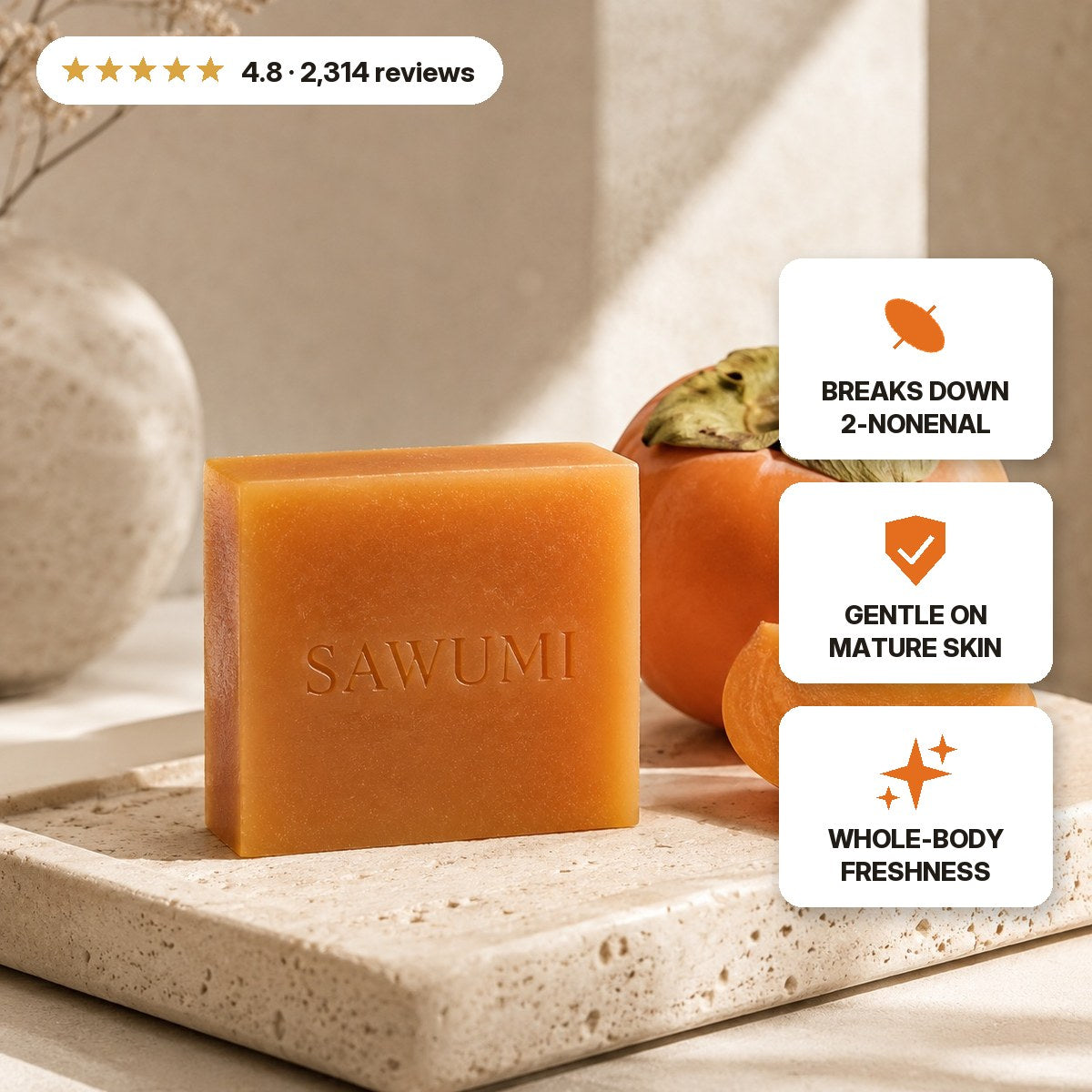
Sawumi persimmon soap
Fermented kakishibu tannin binds the aldehyde. Green tea extract sits in the same bar. 30 days to smell the difference on your own linen, or the order comes back.
See the barThe musty scent has a molecule, a start age, and a short list of things that actually touch it. Perfume is absent from that list.


The skin makes 2-nonenal. The pillowcase stores it. The bar that binds the oil is Sawumi.
People describe it as the smell of a closed room, a wool coat after a long season, a papery note with grease underneath. It is quieter than sweat and harder to get out of cloth. Skin researchers isolated the cause as 2-nonenal, pronounced noh-neh-nahl, an aldehyde. Another aldehyde, cinnamaldehyde, is what gives cinnamon its smell. Same chemical family. Completely different reputation.
Dr. Sonal Choudhary, a dermatologist at the University of Pittsburgh School of Medicine, has said measurable 2-nonenal begins after 40, with a clearer accumulation through the 50s and beyond. Antioxidant defenses in the skin decline. Sebum changes composition. Ultraviolet exposure and everyday stress add oxidative damage, and the aldehyde is what that damage leaves on the surface. Dr. Naana Boakye, founder of Bergen Dermatology, has said studies detect the greasy, grassy scent in older adults of both sexes. Waiting to see if you are the exception is a bet the research does not support.

A scent that builds over years becomes the new normal. Guests still smell the room.
The name for the blind spot is olfactory adaptation. The brain shelves a familiar odor so it can stay alert for a new one. That is why a neighbor's house has a smell and yours, to you, has none. If this aldehyde is rising on your skin, you are the worst witness. The better witnesses are a pillowcase after three nights, a shirt collar at the end of the day, and the person who sits in the passenger seat and goes quiet.
2-nonenal is fatty. Sweat dissolves in soap and water. This molecule clings to skin and then to fabric. Danielle Reed, chief science officer at the Monell Chemical Senses Center, has described that cling in detail: a bath takes some of it, the body replaces it, and the cloth keeps its own share. A hotter shower rehearses the same miss. A stronger deodorant covers a different odor and leaves this one on the skin underneath.
Fermented kakishibu tannin binds the aldehyde. Green tea extract sits in the same bar. 30 days to smell the difference on your own linen, or the order comes back.
See the barBoakye has said products with ingredients that bind aldehydes, tannins included, can reduce how long the odor hangs on. Her example was persimmon soap, which has that mechanism and a long history of use, with the caveat that large randomized trials have not been published. The dermatologists did not pick a brand. Sawumi is the bar made from the ingredient in that sentence: fermented Japanese persimmon tannin, used at the end of a shower on the neck, underarms, chest, feet, and behind the ears.
A bar that only smells like persimmon is a scented soap. Read the ingredient, not the fruit on the label. Kakishibu is the fermented tannin. That is the one this category is about.

Nonenal soaks into pillowcases and collars as a greasy film. Clearing the skin and then sleeping on last month's oil puts it straight back.
Wash the pillowcases, the cardigan that lives on the chair, and the shirt collars when you start the new bar. Otherwise the cloth hands the molecule back to clean skin overnight. Give it a week. The check is specific: the pillowcase should smell like almost nothing, which is the result people are actually chasing.
Eggplant extract, and a compound in it called N-trans-feruloylputrescine, scavenged 2-nonenal in a recent lab study. Dr. Delphine J. Lee at Harbor-UCLA has said the human evidence is too limited to call that a remedy. An older trial of white button mushroom extract looked positive in people aged 50 to 79 and was never repeated at scale. Reed has been blunt that a true way to stop production has not been found. The available move is to wash what the skin has already made, every day, with a tannin that binds it.

The change is biochemical. The exclusion that follows it is social, and it is quiet.
Choudhary has set this next to wrinkles and dryness, a normal change of aging skin, and she has said thoughtful care and proper laundering bring it down. Lee has asked people to spend less fear on odor and more attention on health across a long life. Both things can be true in the same bathroom: the scent is ordinary, and you still get to decide whether it stays on your collar.
The practical version takes one bar and seven mornings. Lather the tannin into the zones. Change the pillowcase. See who leans in the following week.
Advertorial. Written from the dermatology reporting published on Yahoo Health, BuzzFeed, and HuffPost. Those experts did not review Sawumi. Sawumi persimmon soap is a cosmetic for external use. It is not intended to diagnose, treat, cure, or prevent any disease. Results vary.
