The bar dermatologists described
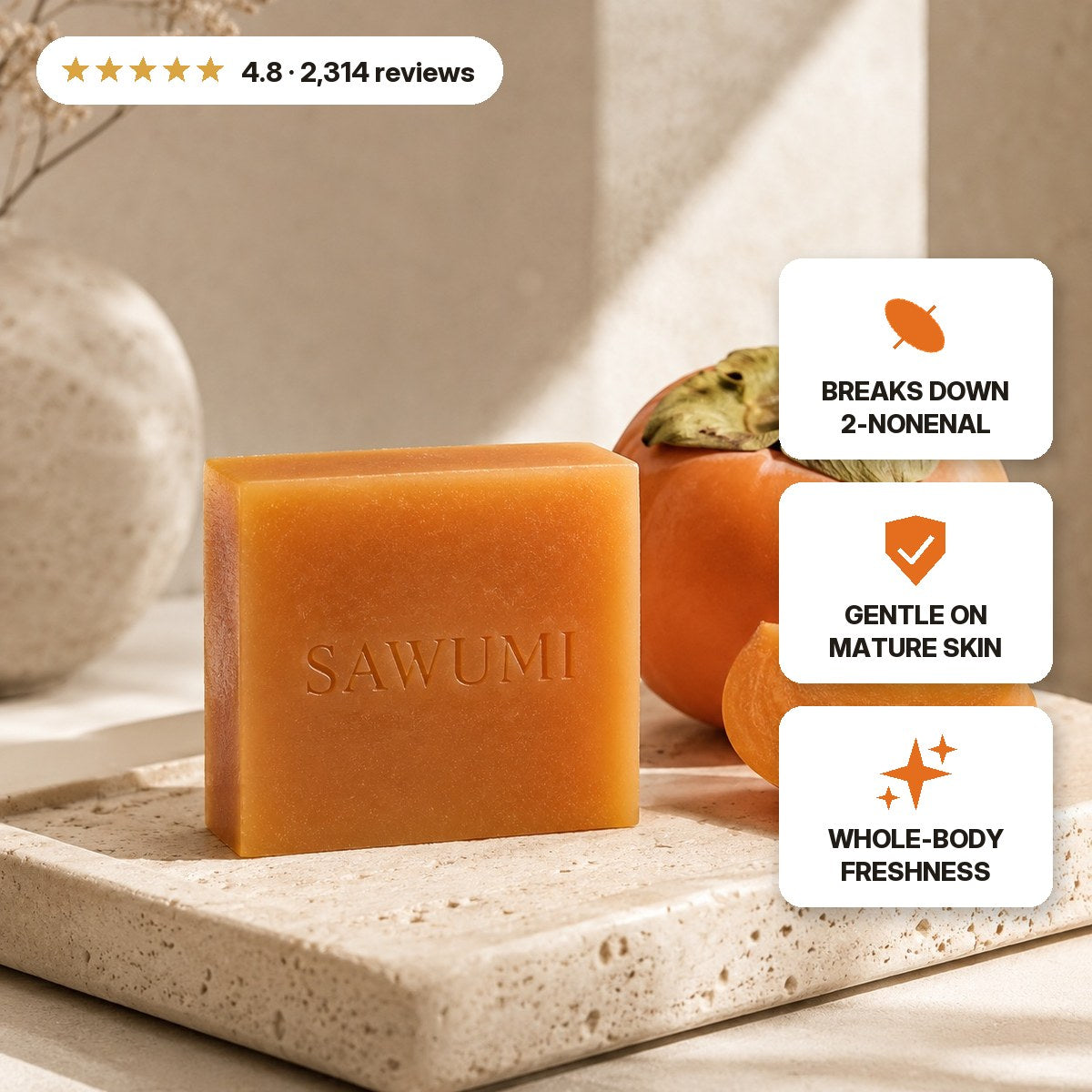
Sawumi persimmon soap
Fermented Japanese persimmon tannin, kakishibu, plus green tea extract. Built to bind the aldehyde a regular wash leaves behind.
See the barThat musty smell is a change in skin oil. It has a name, a start age, and a reason the usual bar of soap leaves it on the pillowcase.


Sawumi persimmon soap. The bar is fermented Japanese kakishibu tannin, with the name stamped in the soap.
Open a spare room that has been shut all winter. The bed is made. The glass is clean. A dry, papery note still sits in the wool blanket, a little greasy if you lean in. Families have a private nickname for it. Chemists published the public one.
The molecule is 2-nonenal, an aldehyde the skin releases in larger amounts as the years add up. After 40, each birthday raises the odds that it is on the skin, in the collar, and in the pillowcase. It is quieter than the sweat smell of a teenager. People still file it, without saying so, under one rude label.

Three shifts arrive together: fewer antioxidants in the skin, a different mix of oil, and a lifetime of sun. The wash for the oil is this bar.
Dr. Sonal Choudhary, a dermatologist at the University of Pittsburgh School of Medicine, has laid out the trio in interviews on this scent. Antioxidant defenses in the skin drop. The composition of sebum changes. A lifetime of ultraviolet light and ordinary environmental stress adds oxidative damage. 2-nonenal is the residue of that oxidation.
She has put the timeline in plain numbers. Measurable increases begin after 40. The buildup is easier to notice through the 50s and later. It is a slope, and the steepness depends on genetics, skin type, and how much sun that skin has already taken.
Dr. Naana Boakye, founder of Bergen Dermatology, has said the studies pick this greasy, grassy scent up in older adults of both sexes. Women produce it. Men produce it. There is no evidence it belongs to a small unlucky group.

Olfactory adaptation is why a guest can smell a house the owner cannot.
A scent that thickens over years gets filed as background. Brains do this with every familiar odor, which is why a friend's hallway has a signature and your own does not. The same filter sits on 2-nonenal. A daughter catches it in the car on a warm afternoon. The driver has been living inside it since the previous spring and will tell you, honestly, that nothing has changed.
Dr. Delphine J. Lee, chief of dermatology at Harbor-UCLA Medical Center, has argued that the scent is less automatic-awful than the nickname suggests. She has said it can read as milder than the body odor of younger adults. The damage is social. Other people decide what the smell means, and they decide it out of earshot.
Fermented Japanese persimmon tannin, kakishibu, plus green tea extract. Built to bind the aldehyde a regular wash leaves behind.
See the bar
2-nonenal is an oily aldehyde. Soap and water were built for sweat and dirt.
Danielle Reed, chief science officer at the Monell Chemical Senses Center, has described 2-nonenal as a molecule that holds onto skin and holds onto cloth. A bath removes a portion. The skin keeps making the next portion. Washing is a reset of hours, and the laundry keeps a copy in the pillowcase.
That is the year of frustration people describe after they have already upgraded the soap, the deodorant, and the perfume. Those products were formulated for a different residue. Perfume sits on the oil for the length of a visit. The oil is still on the skin when the car door closes.

Persimmon tannin has a long history in Japan as a wash for this exact oil. Large clinical trials have not been published.
Boakye has pointed to antioxidant cleansers, and then to ingredients that bind aldehydes. She named persimmon soap, because the tannins have a plausible grip on the molecule and a long record of use. She was equally plain about the gap: large randomized trials have not been run. The dermatologists in that reporting named an ingredient. They did not name a brand, and they did not call any bar a cure.
A paper published last year looked at eggplant, fruit, leaf, stem, and root, and at a compound in it called N-trans-feruloylputrescine. In lab tests the extract scavenged 2-nonenal. Lee has said the human data is still too thin to treat that as a fix. An older study of white button mushroom extract looked encouraging in adults aged 50 to 79. A large follow-up trial never arrived.
Reed's summary of the cure question still holds. A complete way to stop the skin from making the molecule has not been found. What exists is a wash aimed at the oil after the skin has made it.

Choudhary compares the change to wrinkles and dryness. The shame is optional.
Choudhary has set it next to wrinkles and dryness: a biochemical change of aging skin, manageable with thoughtful washing and with laundry that actually clears the oil from cloth. It is not a report card on housekeeping. The people who carry it are the ones who still shower, still press a shirt, and still cannot hear the comment that got made in the kitchen after they left the room.
Lee has asked for a wider frame than odor. Aging is the biological process every person in the article is already inside. The practical question is smaller. If the oil is on the skin, wash the oil.
This page is a Sawumi advertorial written for readers who found the Yahoo Health, HuffPost, and BuzzFeed reporting on 2-nonenal. The dermatologists named above were speaking to those outlets. They have not reviewed Sawumi and they have not endorsed this bar. Sawumi persimmon soap is a cosmetic cleanser for external use. It is not intended to diagnose, treat, cure, or prevent any disease.
